
Go-ahead Lithuanians form European links that are set to translate into business opportunities across the board.
Exploring land of promise in the not-so-far eastern exhibition of exquisite wooden sculpture in the parliament building of Vilnius might seem an unlikely springboard for the promotion of international trade and services, writes James Brewer.
Preview day for prize-winning artwork inspired by Lithuania’s tradition of strongly symbolic crosses and roadside shrines as well as dramatic caricatures was in fact just that.
While sculptor Rimas Metlovas was winning praise for his internationally acclaimed work, his sister Jurga Zilinskiene led business networking among guests representing a range of industries as disparate as insurance, law, shipping, medical services, mining and logistics.
Ms Zilinskiene and fellow directors at her London operation Today Translations had masterminded a unique trade trip which introduced many guests from Britain, Scandinavia and elsewhere to the Lithuanian market.
She herself used the day to launch a group company in Vilnius named UAB Henry Fox, while involving Lithuanian parliamentarians and British diplomats in the networking. The trip coincided with the Queen’s birthday celebrations at the British embassy, led by ambassador Cohn Roberts. Representatives of insurance and other businesses, some already well established in the region, said Lithuania was a small market but an intriguing one.
Some went so far as to say that the venerable capital, built on seven hills and spiked with glorious church architecture, could be the “new Dublin”, a reference to the welcome mat for financial services successfully laid out by the Irish city.
One of the strongest trade ambassadors for Lithuania has been shipping line Kursiu Linija, which operates four Baltic region lines and has just been boosted by Icelandic company Eimskip taking a 50% stake.
Despite this fairly typical cross-border co-operation, people doing business in the region are advised by insiders to recognise that each Baltic state is fiercely independent, and it is a cultural faux pas for any visitor to lump them together in conversation.
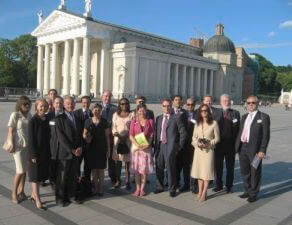
Mr Roberts said that relatively few British businesses had been to Lithuania to explore the opportunities, but more and Taking the tour: Jurga Zilinskiene (second from left) shows business representatives Vilnius Cathedral and other sights as she points to new opportunities for trade in Lithuaniamore Lithuanians like Ms Zilinskiene were finding success in Britain and bringing business back into the Baltic state.
Chiming with this theme, a new book Corporate Investment Opportunities in the New Europe, edited by Jonathan Reuvid lends favour to multinationals using resurgent European states as a platform. He says the advantages of outsourcing to India and China are offset by the high cost of start-up expenses, management time and supervision in far flung locations with unfamiliar regulatory systems and business cultures.
Expansion of the European Union has provided the opportunity to “near-source” from the more vibrant growth economies of the 10 recent entrant states by investing in subsidiary or joint venture operations.
“Directors can now develop a corporate strategy that addresses the twin objectives of international competitiveness and building a market position in a part of Europe with more dynamic growth-potential than their home base” says his book, which analyses conditions in Lithuania and other newcomers alongside the older members.
This is in the context of what is seen as declining competitiveness by the EU generally. In Lithuania, Mr Reuvid once an oil industry economist and investment banker is impressed by its economic stability.
Wages and salaries are said to be among the lowest in Europe, even compared with neighbouring Latvia, and Mr Reuvid says imports of capital goods have enhanced prospects for export growth.
The projected sale of half of the government’s 40% stake in Mazeikiu Nafta, a company which includes the only oil refinery in the Baltic states, and the 14m-tonne Butinge export terminal in an ice-free area of the Baltic Sea, will make a useful dent in gross foreign debt, he expects. Potential foreign investors could regard Lithuania as a relatively stable economy.
For the moment it is wrestling with the break-up of the ruling parliamentary coalition, but there is no question that a highly market orientated, democratic framework is firmly in place 15 years after the end of the Soviet area.
At Today Translations, our linguists know there’s more to professional translation services than mere words. That’s why they come armed with specialist legal, technical, commercial and scientific translation skills. And the knowledge that perfect translation oils the wheels of international business.